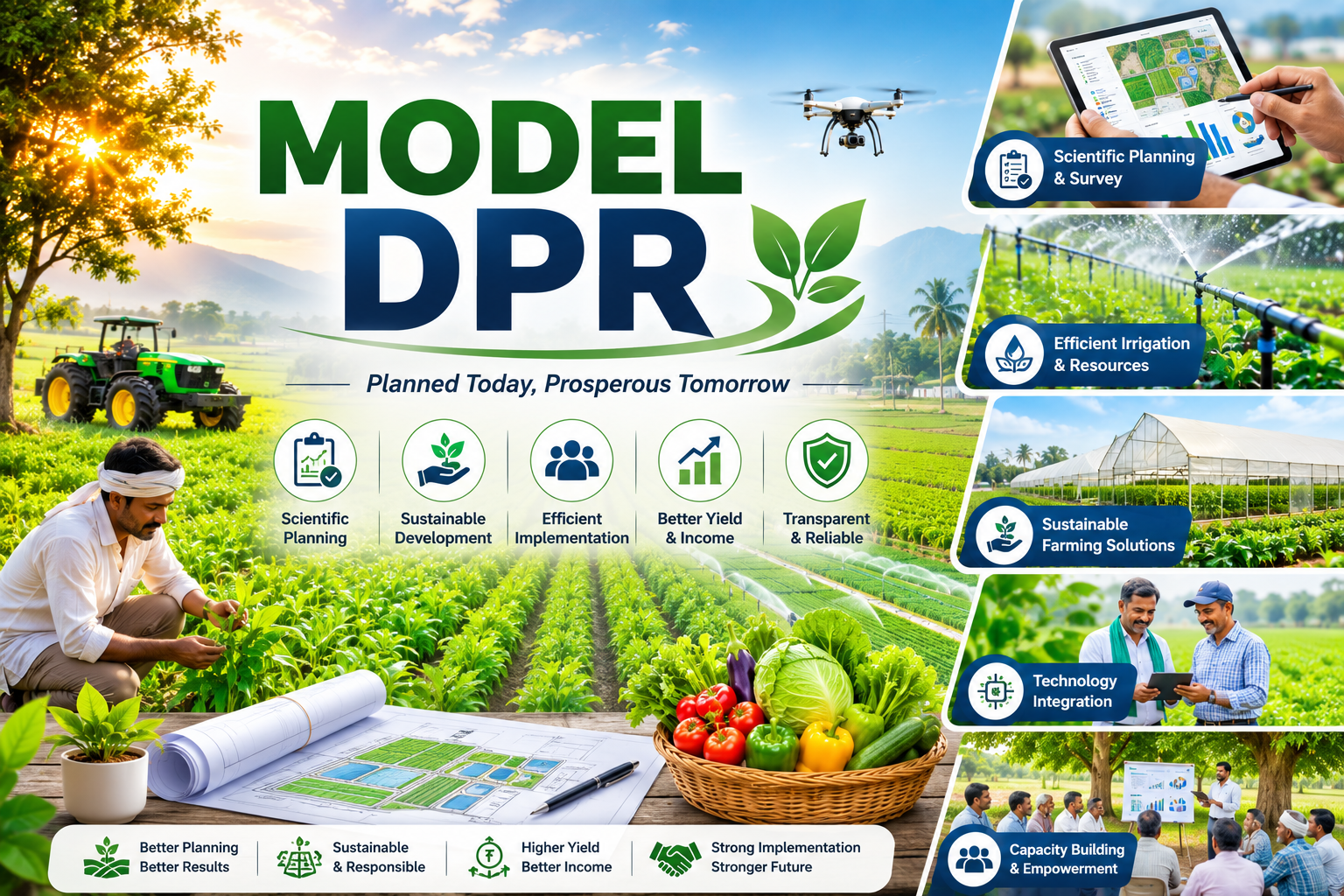
MODEL DPR TEMPLATE
1. Project Overview
The project overview introduces the project and outlines its objectives, significance, and scope. This section should provide a high-level summary of the project’s goals and why it’s necessary.
Subsections:
- Introduction: A brief introduction to the project, including the project’s name, type, and overall purpose.
- Background: Beneficiary details, Location, etc.
- Objectives: Clear and concise project goals.
- Scope: Define the geographical, functional, and technical limits of the project.
- Need/Justification: Why is the project required? Who will benefit, and what problem does it solve?
2. Technical Feasibility
This section evaluates the technical aspects of the project, including the required technology, methodology, and design.
Subsections:
- Technology Requirements: Detailed information about the technologies involved and their readiness for implementation.
- Design: Blueprints, layouts, and technical diagrams that outline the design of the project.
- Resources: List of materials, equipment, and resources required to execute the project.
3. Market Analysis
A solid DPR includes a market analysis that assesses demand, target audience, and competitive landscape.
Subsections:
- Target Audience: Identify the primary customers or users for the project.
- Demand Forecast: Analyze potential demand for the project’s services or products.
- Competition: Study competitors, their offerings, and market share.
- Market Trends: Analysis of recent market trends and how the project aligns with these trends.
4. Detailed split up budget & source of finance
5. Financial Feasibility
The financial feasibility section provides a detailed analysis of the costs involved, funding sources, revenue projections, and profitability estimates.
6. Project Timeline
This section outlines the project’s schedule, from initiation to completion. It’s essential to provide a detailed timeline to ensure the project’s successful and timely execution.
7. Risk Analysis and Mitigation
A DPR should also include an analysis of potential risks associated with the project and the strategies to mitigate them.
8. Management and Team Structure
For successful project execution, a robust management structure is crucial. This section details the team responsible for implementing the project, their roles, and their experience.
Subsections:
- Organizational Structure: A diagram showing the hierarchy of the project team.
- Key Personnel: Profiles of key team members with relevant experience.
- Roles and Responsibilities: A clear definition of roles for each team member involved in the project.
9 Environmental and Social Impact
If the project has any environmental or social implications, it is important to include an analysis of these impacts.
Subsections:
- Environmental Impact Assessment (EIA): Describe any potential environmental impacts and mitigation plans.
- Social Impact: Assess the effect of the project on local communities and stakeholders.
- Sustainability Measures: Include strategies to ensure the project’s sustainability in the long run.
10. Legal and Regulatory Compliance
This section covers the necessary legal and regulatory requirements for the project, ensuring compliance with all applicable laws.
Subsections:
- Licenses and Approvals: List of required licenses, permits, and regulatory approvals.
- Compliance with Local Laws: Ensure that the project adheres to local, state, and national regulations.
11. Outcomes
CHECK LIST FOR PROJECT
- Application and Detailed Project Report in duplicate
- Title deed/ land tax receipt
- In case of lease land, the copy of the lease agreement between the lessee and lessor should be enclosed (Min 10 years).
- Plan and estimate prepared by a Licensed Engineer (civil) / Registered Engineer (civil) for construction works including electrification and sanitary work
- Quotations for the plant and machinery / equipments.
- Quotations for electrical accessories, fittings, generator, transformer etc.
- With regards to credit linked projects, Bank’s approved Appraisal/Process note bearing signature of sanctioning authority as well as loan sanction letter is to be enclosed.
- Personal & Identity Documents (Passport-size photographs of the applicant, Identity Proof: Aadhaar Card, PAN Card, or Voter ID), Address Proof (Recent utility bill or Bank statement or Ration Card)
- Business registrations (e.g., GST certificate, Udyam MSME registration, FSSAI if applicable).
- No Objection Certificate (NOC) from local authorities or pollution control boards (if applicable).